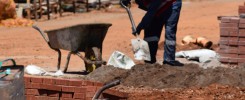
South African civil contractors are concerned about the outlook for the country’s construction sector, as very few new projects are being started.
In the second quarter of 2025, the FNB/BER Civil Confidence Index fell to 41, down from 45 in the first quarter. This is the third consecutive quarter of decline.
Interestingly, activity and overall profitability improved in the second quarter, yet sentiment was lower.
FNB senior economist Siphamandla Mkhwanazi explained that, despite the improved work this quarter, the outlook is relatively downbeat.
The index’s current reading means that nearly 60% of respondents are dissatisfied with prevailing business conditions.
According to Statistics South Africa, the real value of spending on construction works decreased by an annual rate of 2.4% in the first quarter of 2025, pointing to an improvement in the second quarter.
On the back of this improved activity and overall profitability, even the index measuring employment improved.
However, Mkhwanazi explained that the lower sentiment reading in the second quarter was due to a grim outlook for the rest of the year, as there are signs that work may come under strain in future.
“The comments from respondents highlight some of their concerns regarding activity going forward, such as the lack of published tenders, persistent delays in adjudication and, concerningly, a lack of large infrastructure projects in particular,” Mkhwanazi explained.
“Uncertainty regarding future work seemed to weigh on confidence this quarter, especially given the relatively good outcomes for activity and overall profitability.”
Mkhwanazi explained that, based on official data, the survey data and anecdotally, infrastructure projects, particularly large state-led projects, are not as forthcoming as previously hoped.
“Indeed, despite many dialogues, conferences and speeches on infrastructure and its importance to growth and development, we have yet to see this reflected in the form of sustainable construction activity,” he said.
South Africa’s construction industry has been in decline for some time, largely due to a lack of public investment in infrastructure.
Gross fixed capital formation, a metric used to track investment in fixed assets such as infrastructure from public corporations, is less than half of what it was just a decade ago.
These companies, including giants such as Eskom and Transnet, allocated only R110 billion to fixed capital formation in 2024, compared to a peak of R230 billion in 2013.
This is one of the main reasons why South Africa’s infrastructure has deteriorated over the past decade, leading to crises like load-shedding and logistics bottlenecks.
The capital expenditure of public corporations over the past decade has steadily shifted away from maintenance and constructing new infrastructure towards consumption and staff salaries.
This not only leaves South Africa’s physical infrastructure worse off, but has also had a significant impact on the economy and the country’s construction sector.
The overall construction sector has seen its contribution to the country’s economy decline by 33.7% over the past eight years.
This has been driven partly by the emergence of the construction mafia in the key provinces of Gauteng and KwaZulu-Natal, as well as limited government spending on infrastructure.
The decline in mining output in the country is also a contributing factor, with the construction sector’s fortunes being closely tied to those of the mining industry.
This devastating impact on the construction sector has seen industry giants fall behind in recent years.
The best example of this currently is South African construction giant Murray & Roberts, which, after over a century of operation, is unlikely to exist in its current form for much longer.
Murray & Roberts has struggled to overcome multiple headwinds since the relatively prosperous economy of the 2000s created a construction boom preceding the 2010 FIFA World Cup.
After 2010, the company’s operations came under increasing pressure from the country’s economic slowdown, with marginal revenue growth and profit margins straining.
The company was hit particularly hard when De Beers, struggling with declining diamond prices, sharply reduced its contract with Murray & Roberts Cementation.
The De Beers contract accounted for a significant portion of the division’s revenue, creating severe liquidity challenges across Murray & Roberts’ South African operations.
As a result, Murray & Roberts Limited was placed into business rescue in November 2024 and classified as discontinued operations.
In April 2025, the company’s Business Rescue Practitioners presented a plan that included selling Murray & Roberts’ mining assets in South Africa.
This plan is currently being implemented, after which the board plans to recommend to shareholders that the company be wound up.